Since I was lucky enough to be selected to play the Sunday puzzle on March 17th, I’ve discovered how many of my friends listen to the NPR puzzle. I’ve discussed my experience with a few of you and decided to collect my thoughts on it.
Warning – if you don’t want to learn how the magic happens, you may want to stop reading now.
The Puzzle
I feel I might have been the lucky one selected that week because I had good karma and solved the puzzle “properly.” I will often “cheat” to solve the puzzle by using helpful aids such as lists of Nobel prize winners or popular actors. But for this one I just started thinking up parts of the body. I came across “heart” and “ear” pretty quickly. I started trying obvious letters at the beginning of heart and T or S are good guesses. I saw “The Arts” but that was two words not one word, and I wasn’t quite sure it solved the puzzle. I looked around for other options and didn’t find any. I then re-read the puzzle and I know it is often intentionally vague so I figured I could be right. With no better answer it seemed worth submitting something (you can’t win if you don’t enter).
The Call
I usually set an alarm for 3pm on weeks that I enter the puzzle just to remind me to answer the phone if it rings with an odd number. I had forgotten to do that, but I did remember around 3 that the phone might ring. We were in the kitchen and my youngest had just gotten his first college acceptance letter and we were celebrating that. The phone rang around 3:45 with a number I didn’t recognize. Since it was so late, I let it go. Then the same number called again – I figured it was important and answered it. Good thing I did!
The producer asked me a few questions. I suspect I wasn’t as excited as many people she calls because I hadn’t completely mentally shifted from the excitement for my son. She then said we were scheduled to record the segment at 9:30am on Saturday morning and asked if that worked – I muttered something like “Well, it has to doesn’t it?”
After I hung up, I realized I wasn’t pleased with some of my answers to her questions that I came up with on the spot and decided that I needed to prepare my answers for the taping.
The Preparation
I re-listened to a few of the puzzles to remember the normal banter and questions the hosts ask the guests. I drafted responses to those that require some planning – I particularly wanted to make sure the “what do you do” question I answered in a way that felt true to me. Like most of us, I fall into the trap of answering about my job rather than mentioning all other things that are important to me.
The producer also offered to test my setup the day before we recorded which I definitely wanted to do. I wanted to eliminate any uncertainty with the technology so I could focus on the task at hand Saturday morning. For my taping we were all on a Zoom call, but I was also holding my cell phone to my mouth to do a second recording which produced a separate audio track with just my voice1. Honestly, it was a little uncomfortable. Thankfully, my computer headset is a single ear setup that can go on either side, so I was able to hold the phone in my left hand and have my right hand free to write.
The Recording
Of course on the day of the recording I was quite nervous. I had a few things I needed to do at church before the recording, so I had something to distract me. I made sure to be home with plenty of time to take some deep breaths and relax. I hopped on the Zoom shortly before the 9:30am start time. There were two producers from NPR and Greg Pliska came on just after I did. Greg was filling in for Will Shortz since Will had had a stroke in early February. While we were waiting for Ayisha Rascoe to join us, I realized I had an opportunity to reduce my stress by talking with Greg before we started the puzzle. He had mentioned being at Mohonk Mountain House, one of our favorite places, a few weeks previously on the show so I told him we really liked it as well and that led into a discussion about kids and various other things I forget now. By the time Ayisha joined us we were almost old friends and my stress level had dropped considerably. Ayisha was great about putting me at ease when she came on as well.
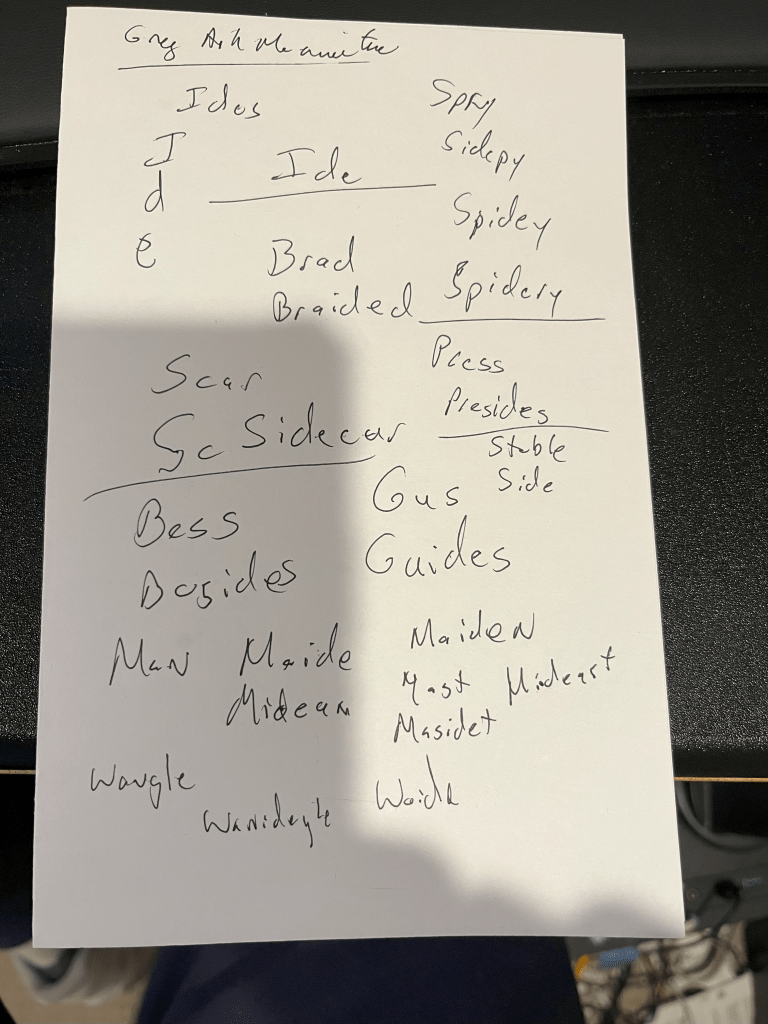
And so we started, and this was a challenging puzzle in some ways. In other ways, however, it was simple, you knew all the letters and their order, you just had to try IDE in each spot. In retrospect I know how I would have done a better job of writing down the words on my paper to make it easier to solve (I’m a visual solver for something like this). Even with the reduced stress, I still felt myself rushing to answer the questions. A couple of extra breaths would have done me some good. I also should have had a larger piece of paper. I’m not sure how I filled it up so quickly.
The Result
I will admit that I didn’t want to listen to the segment for a while. I needed other people to validate that I sounded good before listening to it myself. But when I finally listened to it, I have to admit I was pleased with how it turned out.
The editor did cut the one word I misheard. Greg said “Spry” for “Spidery” and I heard “Spy” and came up with “Spidey” (as in Spidey Sense).
It was cool to see how many people listen to the Sunday puzzle. A number of friends reached out to me and even a couple of months later I will still run into people who tell me that they heard me on NPR.
Tips
If you are lucky enough to play –
- Make sure to enjoy the process of taping. Hey, this is why you’ve sent in answers each week. Relish the moment. It’s a short time – I was on the Zoom for less than 30 minutes and the actual time recording the puzzle was just under 10 minutes.
- Prepare what you can – I wanted to make sure that my “what do you do” answer was thought through. I wrote that out and practiced it. That helped me say what I wanted to say as well as not analyzing what I said once we moved on to the next thing.
- The point of the puzzle isn’t a contest – you’re going to get the same prizes no matter what – so try to see it as a collaboration between the puzzle master, the host and you. It’s much less stressful.
Good luck in getting picked someday. I still listen each week and try to solve the puzzle but am taking a hiatus from submitting for a while. Have to let someone else have a chance.

- I’m not sure which audio track they actually used. My college roommate, John Fujii, believes it was the Zoom recording based on the sound quality of my microphone which he has heard on multiple Zoom meetings. ↩︎

 Some Random Thoughts